Smart waste sorting is rapidly gaining traction in urban communities as cities struggle to manage growing volumes of waste more efficiently and responsibly. Traditional waste collection systems rely heavily on manual sorting and public compliance, which often results in contamination, landfill overflow, and lost recyclable value. In contrast, smart waste sorting uses technology-driven systems to identify, separate, and process waste streams with far greater accuracy.
As urban populations increase and environmental pressures intensify, municipalities are seeking solutions that align operational efficiency with environmental responsibility. Smart waste sorting supports this goal by combining automation, data, and advanced recycling technology to improve outcomes. Its expansion reflects a broader shift toward sustainability and the development of circular cities where waste is treated as a resource rather than a burden.
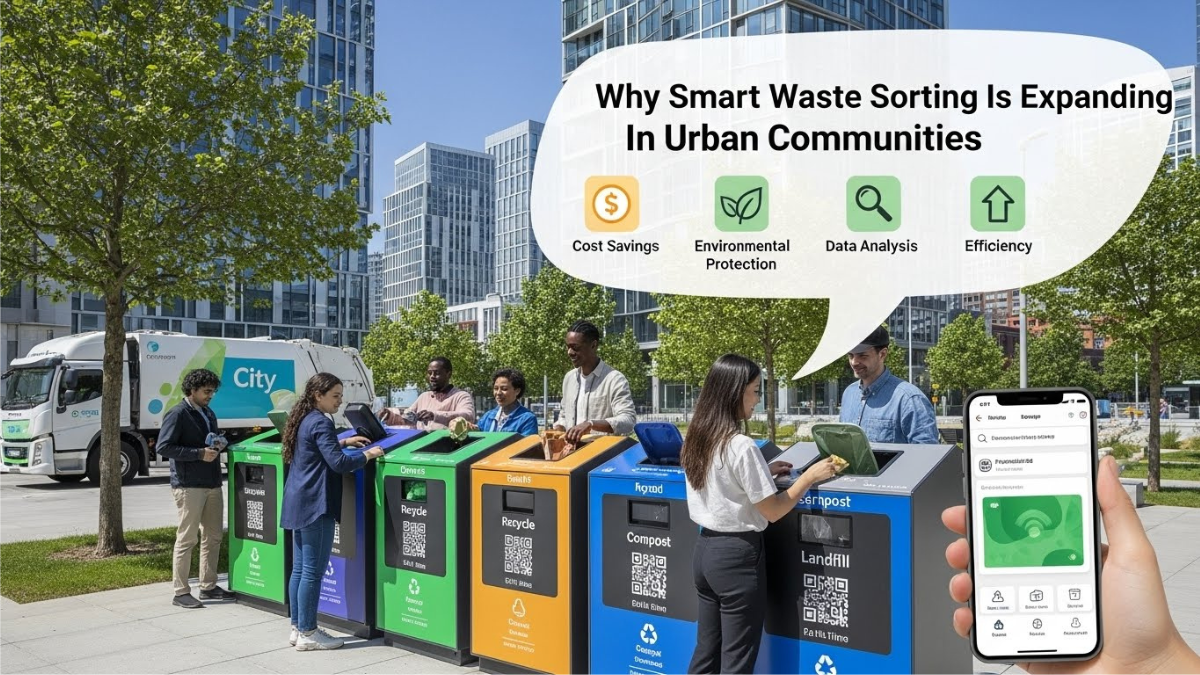
Recycling technology transforming waste management
At the core of smart waste sorting is advanced recycling technology that automates the identification and separation of materials. Optical sensors, artificial intelligence, robotics, and machine vision systems can now distinguish between plastics, metals, paper, glass, and organic waste with high precision. These technologies reduce reliance on manual labor and significantly lower contamination rates.
Improved recycling technology increases recovery rates and ensures that valuable materials re-enter production cycles. When recycling streams are cleaner, processing costs decrease and recycled materials become more commercially viable. This technological leap makes smart waste sorting a practical foundation for scalable urban waste systems focused on long-term sustainability.
Circular cities and closed loop resource systems
The concept of circular cities is central to understanding why smart waste sorting is expanding. Circular cities aim to minimize waste by keeping materials in use for as long as possible through reuse, recycling, and recovery. Smart sorting systems provide the infrastructure needed to support these closed-loop models by ensuring materials are properly separated at scale.
Without effective sorting, circular systems fail because mixed or contaminated waste cannot be efficiently reused. Smart waste sorting enables cities to move beyond linear “take-make-dispose” models and toward regenerative systems. By supporting circular cities, smart sorting technologies help urban areas reduce resource extraction, emissions, and environmental impact while strengthening local economies.
Sustainability goals and climate commitments
Municipal sustainability goals are another major driver behind the adoption of smart waste sorting. Waste management contributes significantly to greenhouse gas emissions, particularly when organic waste decomposes in landfills. Smart sorting systems help divert recyclables and organics away from landfills, reducing methane emissions and supporting climate targets.
Cities pursuing ambitious sustainability commitments increasingly view waste systems as critical infrastructure rather than back-end services. By integrating recycling technology into waste operations, urban leaders can measure performance, track diversion rates, and demonstrate progress toward environmental goals. Smart waste sorting thus becomes both an operational solution and a policy tool.
Key reasons cities are adopting smart waste sorting include:
- Higher accuracy enabled by recycling technology
- Reduced landfill dependency
- Support for circular cities strategies
- Measurable improvements in sustainability
- Lower long-term waste management costs
The table below compares traditional waste sorting with smart waste sorting systems:
| Aspect | Traditional Waste Sorting | Smart Waste Sorting |
|---|---|---|
| Sorting method | Manual or basic mechanical | AI and sensor-based |
| Contamination rates | High | Low |
| Recycling efficiency | Limited | High |
| Circular cities support | Weak | Strong |
| Sustainability impact | Moderate | Significant |
Operational efficiency and cost implications
While smart waste sorting systems require upfront investment, they offer long-term operational benefits. Automated sorting reduces labor costs, improves throughput, and minimizes errors. Over time, cities recover value from higher-quality recyclables, offsetting initial expenses and stabilizing waste budgets.
Data generated by smart waste sorting systems also improves planning. Cities can analyze waste composition trends, adjust collection strategies, and optimize infrastructure placement. This data-driven approach aligns waste management with broader sustainability and circular cities planning, ensuring resources are deployed where they deliver the greatest impact.
Public behavior, education, and participation
Although technology plays a central role, public participation remains important. Smart waste sorting reduces dependence on perfect sorting behavior, but education still matters. Clear communication about waste streams and system benefits encourages cooperation and trust.
In many cities, smart bins provide feedback through indicators or apps, reinforcing positive behavior. When residents see tangible outcomes from improved recycling technology, engagement increases. This collaboration between systems and citizens strengthens the foundation for circular cities and shared sustainability responsibility.
Equity and urban inclusion considerations
Equitable access is an emerging consideration in smart waste sorting deployment. Low-income neighborhoods often experience higher waste burdens and fewer recycling resources. Expanding smart sorting infrastructure across all communities helps ensure environmental benefits are distributed fairly.
Inclusive implementation supports sustainability not just environmentally but socially. When all neighborhoods benefit from cleaner streets, reduced pollution, and improved waste services, trust in urban governance increases. Smart waste sorting thus contributes to healthier, more resilient circular cities.
Future of smart waste sorting in cities
Looking ahead, smart waste sorting is expected to integrate more deeply with smart city platforms. Real-time data sharing, predictive analytics, and system interoperability will further enhance performance. Advances in recycling technology will continue to improve accuracy and reduce costs.
As regulatory pressure and environmental awareness grow, smart waste sorting will likely become a standard feature of urban infrastructure. Its role in enabling circular cities and advancing sustainability positions it as a cornerstone of future urban development strategies.
Conclusion
In conclusion, smart waste sorting is expanding in urban communities because it delivers practical solutions to waste challenges while supporting recycling technology, circular cities, and long-term sustainability goals. By improving efficiency, reducing contamination, and enabling resource recovery, smart sorting systems transform waste from a liability into an asset. As cities evolve to meet environmental and social demands, smart waste sorting will remain a critical component of resilient, sustainable urban systems.
FAQs
What is smart waste sorting?
Smart waste sorting uses advanced technology to automatically identify and separate different types of waste.
How does recycling technology improve waste sorting?
Recycling technology uses sensors and AI to increase accuracy and reduce contamination.
Why is smart waste sorting important for circular cities?
It ensures materials are properly separated so they can be reused within circular cities systems.
Does smart waste sorting support sustainability goals?
Yes, it reduces landfill use and emissions, supporting broader sustainability targets.
Is smart waste sorting expensive for cities?
While initial costs exist, long-term savings and efficiency gains often outweigh them.
Click here to know more.